A Tale of Two Chairmanships: The First 18 Months of SEC Crypto Enforcement
Comparing the first 18 months under Gary Gensler and Paul Atkins: fewer new crypto cases, a larger share filed in federal court, and fraud alleged in every one.
 By Simona MolaDirector, NERA Economic Consulting · November 3, 2026 · 11 min read
Xin@
Independent contribution. Not sponsored. The author’s views are her own and are not legal, tax or financial advice.
- Fewer cases: the SEC brought 16 crypto enforcement actions in Paul Atkins’ first 18 months as chairman, against 38 in Gary Gensler’s. Fifteen of the 16 were filed in federal court.
- Fraud in every case: all 16 Atkins-period actions alleged fraud, against about 71% under Gensler. Registration claims still appeared, but only alongside fraud.
- Remedies: total monetary remedies fell about 77%, to $181.5 million from $783.6 million, but one $539.4 million order made up about 69% of the Gensler total, and remedies in federal court nearly doubled.
The Securities and Exchange Commission’s (SEC’s) approach to crypto assets has evolved considerably over the past several years. A comparison of the first 18 months of Gary Gensler’s and Paul Atkins’ chairmanships provides an empirical perspective on how the agency’s enforcement activity has changed.1
Public statements by the two chairmen illustrate different emphases in their approaches to crypto regulation and enforcement. In September 2022, Gensler observed that, “Of the nearly 10,000 tokens in the crypto market, I believe the vast majority are securities. Offers and sales of these thousands of crypto security tokens are covered under the securities laws.”2 Gensler’s approach drew criticism for relying on “regulation by enforcement.”3 By contrast, in May 2025, Atkins identified establishing “clear rules of the road for the issuance, custody, and trading of crypto assets” as a priority, favoring notice-and-comment rulemaking while policing violations of established obligations, particularly fraud and manipulation.4
The two periods also saw different institutional developments. In May 2022, during Gensler’s first 18 months, the SEC announced the expansion of its Crypto Assets and Cyber Unit within the Division of Enforcement, allocating 20 additional positions and increasing the unit’s planned staffing to 50. Gensler emphasized the importance of dedicating additional resources to protecting investors in crypto markets.5 In February 2025, before Atkins assumed office, the SEC replaced the Crypto Assets and Cyber Unit with the Cyber and Emerging Technologies Unit, comprising approximately 30 fraud specialists and attorneys across multiple SEC offices.6 Meanwhile, in fiscal year 2025, the SEC’s Division of Enforcement as a whole experienced an 18% staff attrition rate.7
Against this backdrop, this article examines differences in enforcement volume, the nature of alleged violations, the use of administrative proceedings versus federal court litigation, and the monetary remedies ordered during each period.
1. A Different Mix of Enforcement Actions
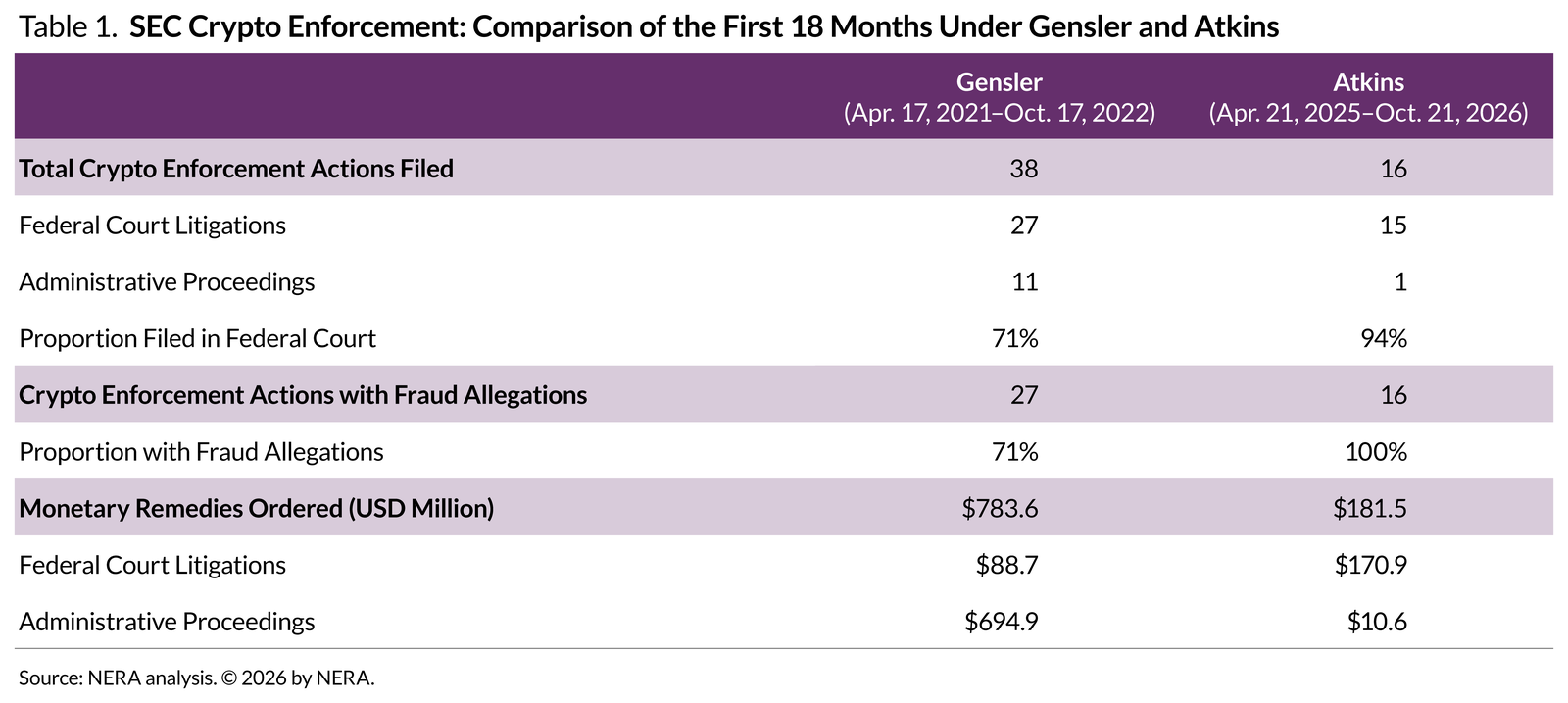
The decline in newly initiated crypto enforcement actions was accompanied by a change in the relative use of administrative proceedings and federal court litigation. During Gensler’s first 18 months as SEC chairman, the SEC initiated 38 crypto-related enforcement actions, including 27 federal court litigations and 11 administrative proceedings. During Atkins’ first 18 months, the SEC initiated 16 crypto-related enforcement actions: 15 federal court litigations and one administrative proceeding.
Although the choice of enforcement forum also depends on the nature of the alleged violations, the remedies sought, and applicable jurisdictional and procedural requirements, the data show that newly initiated crypto enforcement activity during Atkins’ first 18 months was concentrated in federal court. Federal court litigation accounted for nearly 94% of the actions initiated during Atkins’ first 18 months, compared with approximately 71% during Gensler’s first 18 months. Conversely, administrative proceedings represented only 6% of the Atkins-period actions, compared with approximately 29% of the Gensler-period actions. This shift may be partly attributable to the Supreme Court’s June 2024 decision in SEC v. Jarkesy, which held that defendants are entitled to a jury trial when the SEC seeks civil penalties for securities fraud.8
In addition to initiating fewer enforcement actions, the SEC also moved to dismiss certain inherited crypto-related litigations during Atkins’ first 18 months. In April and May 2025, for example, the SEC filed joint stipulations to dismiss SEC v. Dragonchain Inc., SEC v. Ian Balina, and SEC v. Binance Holdings Limited et al., which had been initiated during Gensler’s tenure. The stipulations referred to the establishment of the SEC’s Crypto Task Force in January 2025 to develop the regulatory framework for crypto assets and stated that, “in the exercise of its discretion and as a policy matter,” the SEC considered dismissal appropriate.9 The SEC also agreed to dismiss remaining claims in other inherited crypto-related litigations, including SEC v. Genesis Global Capital et al. and SEC v. Nader Al-Naji, citing case-specific circumstances rather than expressly invoking broader policy considerations as the basis for dismissal.10
2. Fraud at the Center of New Enforcement Actions
A further difference emerges when examining the underlying allegations. Of the 38 crypto-related enforcement actions initiated during Gensler’s first 18 months, 27 contained allegations of fraudulent conduct, representing approximately 71% of the total. By comparison, all 16 actions initiated during Atkins’ first 18 months contained allegations of fraudulent conduct.
While fraud allegations were present in the majority of the Gensler-period actions, a number of enforcement actions included alleged violations of securities-law requirements without fraud claims. These included violations of Sections 5(a) and 5(c) of the Securities Act of 1933, which prohibit unregistered offers and sales of securities, absent an applicable exemption. Certain proceedings also involved Section 17(b) of the Securities Act, which requires disclosure of certain compensation received for promoting securities. Other actions involved registration requirements for securities exchanges and broker-dealers under Sections 5 and 15 of the Exchange Act of 1934.
During Atkins’ first 18 months, no newly initiated crypto enforcement action was based exclusively on these non-fraud theories. This does not mean, however, the SEC has abandoned registration enforcement. Seven of the 16 crypto-related enforcement actions filed during the Atkins period alleged violations of Sections 5(a) and 5(c) of the Securities Act alongside fraud allegations. One complaint, SEC v. Goliath Ventures, also alleged unregistered broker activity under Section 15(a)(1) of the Exchange Act alongside fraud allegations.11
The distinction lies not in the absence of registration allegations under Atkins but in their inclusion alongside fraud claims.
The newer complaints encompass different types of alleged misconduct, including Ponzi-like investment schemes, misappropriation, fictitious crypto trading platforms, misleading token offerings, and fraudulent crypto-mining and investment-management arrangements. For example, in SEC v. Goliath Ventures, filed in August 2026, the SEC alleged defendants raised hundreds of millions of dollars through a decentralized-finance investment program that operated as a Ponzi-like scheme.12 In September 2026, the SEC brought actions against Cryptoaiml and TSAI Pro, alleging fraudulent investment schemes involving purported AI-based crypto trading platforms.13
3. Monetary Remedies
The comparison of monetary remedies ordered during the two chairmanships reveals other differences. Overall monetary remedies, including disgorgement, prejudgment interest, and civil penalties, were approximately 77% lower during the Atkins period. During their respective first 18 months, monetary remedies ordered in crypto-related enforcement actions totaled approximately $783.6 million under Gensler, compared with $181.5 million under Atkins. However, monetary remedies ordered in federal court litigation nearly doubled, from $88.7 million under Gensler to $170.9 million under Atkins.
The influence of unusually large awards is particularly important when interpreting these totals. In September 2021, the SEC entered an administrative order against GTV Media Group et al., imposing approximately $539.4 million in connection with unregistered securities offerings involving stock and digital assets.14 That single proceeding accounted for approximately 69% of all monetary remedies ordered during Gensler’s first 18 months. Excluding this proceeding, the aggregate would decline to approximately $244.2 million, substantially narrowing the difference between the two periods.
The timing of monetary remedies also complicates the comparison, as remedies may be ordered under a different chairmanship from the one during which the enforcement action was initiated. SEC v. MCC International Corp. provides a particularly illustrative example. Filed in April 2022, during Gensler’s first 18 months, the action involved allegations of a fraudulent crypto-mining and investment program. In August 2025, during Atkins’ first 18 months, a final judgment was entered ordering approximately $46.3 million in monetary remedies.15 The judgment accounted for approximately one quarter of the monetary remedies ordered during Atkins’ first 18 months.
4. Regulatory Clarification and Rulemaking Alongside Enforcement
During Atkins’ first 18 months, the SEC pursued several initiatives aimed at clarifying the application of federal securities laws to crypto assets. Alongside the decline in enforcement actions discussed above, these initiatives reflect a greater emphasis on regulatory clarification and rulemaking.
These efforts followed the establishment of the Crypto Task Force in January 2025 and the launch of Project Crypto in July 2025, through which Atkins outlined an agenda to modernize the SEC’s regulatory framework for crypto markets.16 Three developments are particularly significant.
In March 2026, the SEC issued an interpretation clarifying the application of federal securities laws to certain crypto assets and transactions, including the distinction between crypto assets and investment contracts involving those assets. The interpretation included guidance from the Commodity Futures Trading Commission (CFTC).17
In August 2026, the SEC proposed Regulation Crypto Assets, which would provide for tailored exemptions from securities-registration requirements and a conditional safe harbor addressing investment-contract status, while retaining applicable antifraud protections.18
In September 2026, the SEC granted temporary, conditional exemptive relief for certain trading activities involving tokenized National Market System (NMS) stocks and solicited public comment.19
Together, these initiatives illustrate the SEC’s efforts to address questions concerning crypto-asset offerings and trading activities through interpretations, rulemaking, and targeted exemptions, alongside enforcement.
5. Conclusion
The comparison of the first 18 months of the Gensler and Atkins chairmanships reveals differences not only in the volume of SEC crypto enforcement actions but also in their composition. During Atkins’ first 18 months, the SEC initiated fewer actions, brought a higher proportion of cases in federal court, and exclusively brought actions containing fraud allegations. Registration claims remained part of the enforcement framework but accompanied allegations of fraudulent conduct rather than serving as standalone theories in the reviewed sample.
The monetary-remedies comparison adds another dimension. Although aggregate remedies were substantially lower during Atkins’ first 18 months, the difference was influenced in part by unusually large awards. Notably, despite the overall decline, monetary remedies ordered in federal court litigation increased substantially under Atkins. Viewed alongside the SEC’s regulatory initiatives, these findings suggest an evolving approach to crypto markets in which regulatory clarification and enforcement litigation serve complementary roles.
Notes and sources (19)
- NERA analysis of SEC crypto-related enforcement actions initiated, dismissed, or resolved during the first 18 months of the Gensler (April 17, 2021–October 17, 2022) and Atkins (April 21, 2025–October 21, 2026) chairmanships, using SEC enforcement releases, administrative orders, and federal court filings. The first 18 months are used to compare enforcement activity at similar stages of each chairmanship, allowing time for leadership priorities to take shape. Underlying information was obtained from SEC.gov and federal court dockets accessed through Lex Machina. ↩︎
- Gary Gensler, Chairman, SEC, Kennedy and Crypto, Remarks at SEC Speaks (Sept. 8, 2022), available at https://www.sec.gov/newsroom/speeches-statements/gensler-sec-speaks-090822. ↩︎
- See, e.g., Hester M. Peirce, Commissioner, SEC, Outdated: Remarks before the Digital Assets at Duke Conference (Jan. 20, 2023), available at https://www.sec.gov/newsroom/speeches-statements/peirce-remarks-duke-conference-012023 (“Why not set forth a coherent legal framework in a rule? After all, if we continued with our regulation-by-enforcement approach at our current pace, we would approach 400 years before we got through the tokens that are allegedly securities. By contrast, an SEC rule would have universal—albeit not retroactive—coverage as soon as it took effect.”). ↩︎
- Paul S. Atkins, Chairman, SEC, Testimony Before the United States House Appropriations Subcommittee on Financial Services and General Government (May 20, 2025), available at https://www.sec.gov/newsroom/speeches-statements/atkins-testimony-fsgg-052025. ↩︎
- SEC, SEC Nearly Doubles Size of Enforcement’s Crypto Assets and Cyber Unit, Press Release No. 2022-78 (May 3, 2022), available at https://www.sec.gov/newsroom/press-releases/2022-78. ↩︎
- SEC, SEC Announces Cyber and Emerging Technologies Unit to Protect Retail Investors, Press Release No. 2025-42 (Feb. 20, 2025), available at https://www.sec.gov/newsroom/press-releases/2025-42. ↩︎
- U.S. Government Accountability Office, Securities And Exchange Commission: Recent Workforce Reductions and Other Personnel Management Changes, GAO-26-107813 (2026), available at https://www.gao.gov/products/gao-26-107813; Paul S. Atkins, Chairman, SEC, Testimony Before the United States House Appropriations Subcommittee on Financial Services and General Government (May 20, 2025), available at https://www.sec.gov/newsroom/speeches-statements/atkins-testimony-fsgg-052025. ↩︎
- SEC v. Jarkesy, 603 U.S. 109 (2024). ↩︎
- Joint Stipulation to Dismiss, and Releases, SEC v. Dragonchain, Inc., No. 2:22-cv-01145, ECF No. 43 (W.D. Wash. Apr. 24, 2025); Joint Stipulation to Dismiss, and Releases, SEC v. Ian Balina, No. 1:22-cv-00950, ECF No. 60 (W.D. Tex. May 1, 2025); Joint Stipulation to Dismiss and Releases, SEC v. Binance Holdings Limited et al., No. 1:23-cv-01599, ECF No. 301 (D.D.C. May 29, 2025). ↩︎
- Joint Stipulation to Dismiss, and Releases, SEC v. Genesis Global Capital, LLC et al., No. 1:23-cv-00287, ECF No. 86 (S.D.N.Y. Jan. 28, 2026); Joint Stipulation of Dismissal, and Releases, SEC v. Al-Naji, No. 1:24-cv-05738, ECF No. 61 (S.D.N.Y. Mar. 13, 2026). ↩︎
- Complaint for Injunctive and Other Relief, SEC v. Goliath Ventures Inc. et al., No. 6:26-cv-01741, ECF No. 1 (M.D. Fla. Aug. 11, 2026). ↩︎
- Id. ↩︎
- Complaint, SEC v. Cryptoaiml Ltd. et al., No. 1:26-cv-08508, ECF No. 1 (S.D.N.Y. Sept. 29, 2026) and Complaint, SEC v. TSAI Pro Ltd. et al., No. 1:26-cv-08518, ECF No. 1 (S.D.N.Y. Sept. 29, 2026). ↩︎
- SEC, SEC Charges Three Media Companies with Illegal Offerings of Stock and Digital Assets, Press Release No. 2021-175 (Sept. 13, 2021), available at https://www.sec.gov/newsroom/press-releases/2021-175; In the Matter of GTV Media Group, Inc., Saraca Media Group, Inc., and Voice of Guo Media, Inc., Securities Act Release No. 33-10979 (Sept. 13, 2021). ↩︎
- Complaint, SEC v. MCC International Corp. et al., No. 2:22-cv-14129, ECF No. 1 (S.D. Fla. Apr. 7, 2022); Order on Report & Recommendation, SEC v. MCC International Corp. et al., No. 2:22-cv-14129, ECF No. 192 (S.D. Fla. Aug. 26, 2025). ↩︎
- SEC, SEC Crypto 2.0: Acting Chairman Uyeda Announces Formation of New Crypto Task Force, Press Release No. 2025-30 (Jan. 21, 2025), available at https://www.sec.gov/newsroom/press-releases/2025-30; Paul S. Atkins, Chairman, SEC, American Leadership in the Digital Finance Revolution, Remarks at the America First Policy Institute (July 31, 2025), available at https://www.sec.gov/newsroom/speeches-statements/atkins-digital-finance-revolution-073125. ↩︎
- SEC, Application of the Federal Securities Laws to Certain Types of Crypto Assets and Certain Transactions Involving Crypto Assets, Securities Act Release No. 33-11412, Exchange Act Release No. 34-105020 (Mar. 17, 2026), available at https://www.sec.gov/rules-regulations/2026/03/s7-2026-09. ↩︎
- SEC, Regulation Crypto Assets, Proposed Rule, Securities Act Release No. 33-11434, Exchange Act Release No. 34-106150 (Aug. 18, 2026), available at https://www.sec.gov/rules-regulations/2026/08/s7-2026-27. ↩︎
- SEC, SEC Issues “Innovation Exemption” to Facilitate the Trading of Tokenized NMS Stock and Request for Comment, Press Release No. 2026-90 (Sept. 17, 2026) and SEC, Order Granting Temporary Conditional Exemptive Relief, Pursuant to Section 36(a)(1) of the Securities Exchange Act of 1934, from the Definition of “Exchange” in Section 3(a)(1) of the Exchange Act for the Use of Certain Distributed Ledger Trading Venues for Tokenized NMS Stocks and from the Definition of “Dealer” in Section 3(a)(5) of the Exchange Act for Certain Liquidity Providers for Tokenized NMS Stocks, and Request for Comment, Exchange Act Release No. 34-106402 (Sept. 17, 2026), available at https://www.sec.gov/files/rules/exorders/2026/34-106402.pdf. ↩︎
Simona Mola
Director, NERA Economic Consulting
Simona Mola, PhD, is a Director at NERA. She has published on crypto-related regulatory issues and enforcement trends. Prior to joining the firm, she served as assistant director and senior policy advisor at the U.S. Securities and Exchange Commission.
Read more about Simona →Share your voice
Are you an expert in crypto law, policy, markets or technology? Voices is where you can share your view with Cryptoweek readers, in your own words and under your own name.