
What is a 51% attack?
A 51% attack is when one party controls most of a blockchain's mining power or staked coins and uses it to reverse or block recent transactions.
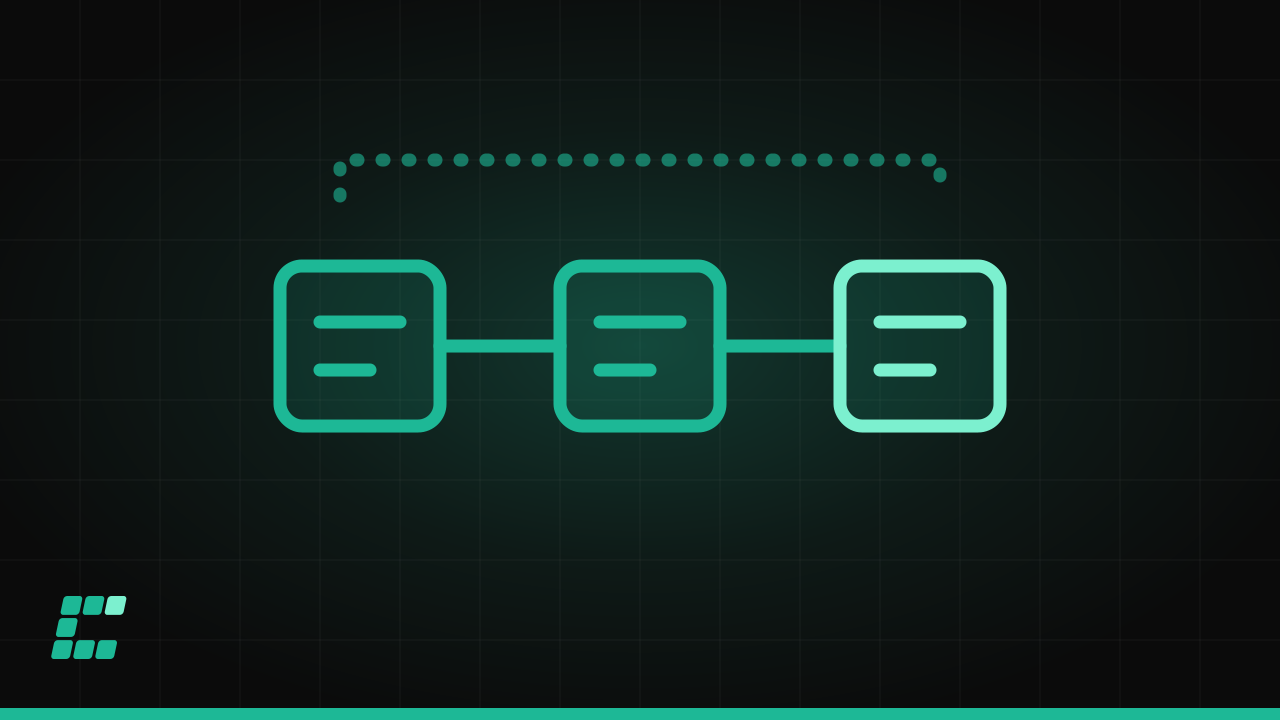
A 51% attack is when one person or group gains control of more than half of a blockchain's mining power or staked coins and uses it to rewrite recent transactions. It has happened on smaller networks, though not on bitcoin.
How does a 51% attack work?
On a proof-of-work chain, computers follow whichever version of the chain has the most computing work behind it. The consensus mechanism assumes no single party can outpace everyone else.
A party with a majority of the mining power breaks that assumption. It can build a private version of the chain faster than the rest of the network builds the public one. When it publishes the longer private chain, the network switches over, and the recent blocks on the old chain are thrown out.
The usual aim is a double spend. The attacker pays someone on the public chain, receives goods or another asset in return, then releases a private chain in which that payment never happened.
What can an attacker do, and not do?
With majority control, an attacker can:
- Reverse its own recent transactions.
- Keep other people's transactions out of blocks, at least for a while.
- Collect most of the block rewards while the attack lasts.
It cannot:
- Spend coins from someone else's wallet. That requires the owner's private key.
- Create coins out of nothing or raise its own reward. Nodes reject blocks that break the rules.
- Easily alter old history. Every extra block that must be redone adds to the cost.
Has it happened?
Yes, on smaller chains. Bitcoin Gold was attacked in 2018. Ethereum Classic was hit in January 2019 and again several times in August 2020, with double spends worth millions of dollars reported.
Small proof-of-work networks are exposed because the computing power needed to overwhelm them is modest and can sometimes be rented by the hour.
Bitcoin has never suffered a successful 51% attack. It has come close to the threshold once. In 2014, a single mining pool briefly reached about half of the network's power, and miners left it voluntarily after an outcry.
Why are big networks costly to attack?
An attacker on bitcoin would need more specialized mining hardware than all other miners combined, plus the electricity to run it. A visible attack would also be likely to crash the coin's price, wiping out the value of the attacker's equipment and loot.
Proof-of-stake networks such as Ethereum rely on a different deterrent. An attacker would have to buy a very large share of all staked coins, which would drive up the price, and could then have that stake destroyed as a penalty. The guide to validators explains how.
Critics note that the threshold is less remote than it sounds. A handful of mining pools coordinate most of bitcoin's computing power, and staking is concentrated among a few large services.
This guide explains how things work. It is not financial, legal or tax advice. Last updated .