
What is crypto mining and how does it work?
Crypto mining is a competition among computers to add the next block to a blockchain. The winner earns new coins and fees, and the race secures the network.
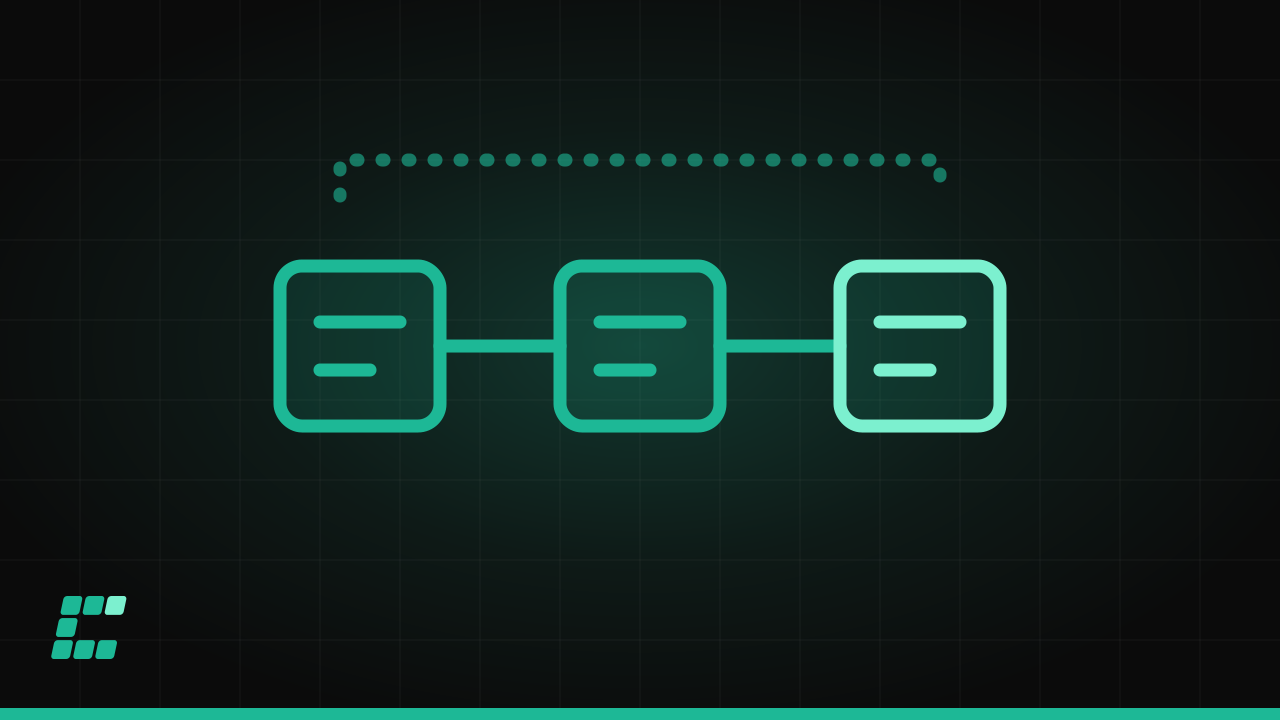
Crypto mining is the process by which computers compete to add new blocks of transactions to a proof-of-work blockchain such as bitcoin. The winner of each round earns newly created coins and transaction fees.
How does crypto mining work?
A miner gathers pending transactions into a candidate block. It then runs the block through a formula that produces a hash, a digital fingerprint, and checks whether the result falls below a target set by the network. If not, it changes one number in the block and tries again.
The first miner to find a valid hash broadcasts the block. Other computers on the network verify it with a single calculation, and the race restarts. The method is called proof of work.
The reward has two parts: new coins and the fees paid by the transactions in the block. Bitcoin's new-coin reward started at 50 bitcoin in 2009 and is cut in half about every four years, an event called the halving. It fell to 3.125 bitcoin in April 2024.
What do miners need?
- Hardware. Early bitcoin could be mined on a home computer. It now takes machines called ASICs, chips built to do this one calculation and nothing else.
- Electricity. Power is the main running cost, so large operations set up where it is cheapest.
- A pool. A lone miner might go years without winning a block. Most join pools that combine computing power and split the rewards. A few large pools produce most bitcoin blocks, which critics say concentrates control.
The puzzle also adjusts. Bitcoin resets its difficulty about every two weeks so that blocks keep arriving roughly every 10 minutes. The guide to bitcoin mining goes further.
Not every cryptocurrency is mined. Ethereum ended mining in September 2022 and now relies on validators.
Is crypto mining legal?
In the United States, generally yes. No federal law prohibits it. On March 20, 2025, staff of the Securities and Exchange Commission said that mining on public proof-of-work networks, alone or through a pool, does not involve the sale of securities. That is a staff view and does not carry the force of law. The Internal Revenue Service treats mined coins as income, valued on the day they are received.
Elsewhere the picture varies. China, once a leading center of mining, moved in 2021 to shut the industry down, with its economic planning agency listing it as a sector to be phased out. Kuwait's markets regulator prohibited mining in July 2023. Rules differ by country and state and they change, so anyone affected should check the official source or a qualified professional.
What are the criticisms?
The main one is energy. Mining consumes large amounts of electricity by design, and critics cite carbon emissions, strain on local grids and noise. The industry replies that miners often use surplus or renewable power.
This guide explains how things work. It is not financial, legal or tax advice. Last updated .