
What is a consensus mechanism?
A consensus mechanism is the set of rules that lets computers on a blockchain agree on one version of the ledger without a central authority.
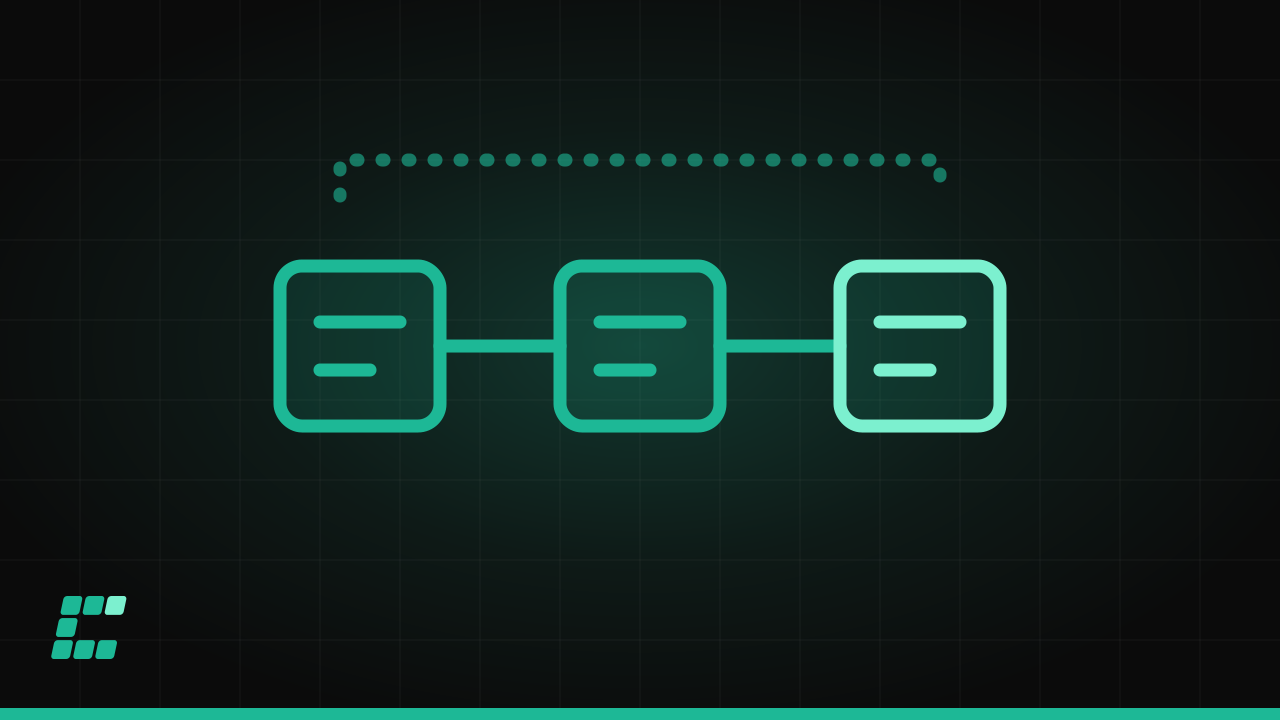
A consensus mechanism is the set of rules a blockchain network uses to agree on which transactions are valid and in what order they happened. It lets thousands of computers that do not know or trust one another keep one identical ledger.
What problem does it solve?
Digital money is data, and data can be copied. Without a referee, someone could send the same coin to two people at once. This is called the double-spend problem. Banks solve it by keeping a central ledger and deciding which payment counts.
A blockchain has no central keeper, so the network itself must choose one version of events when two conflict. A simple vote does not work, because one person can cheaply run a million fake computers. Consensus mechanisms get around this by tying influence to something scarce and costly.
How does proof of work do it?
Proof of work was introduced by the bitcoin white paper, published on October 31, 2008. The scarce resource is computing power, and behind it electricity. Participants called miners race to solve a puzzle, and the winner adds the next block and collects a reward. The process is described in the guide to crypto mining.
Honest computers follow the chain with the most accumulated work behind it. To rewrite history, a cheat would need to out-compute everyone else combined, a scenario known as a 51% attack.
How does proof of stake do it?
Here the scarce resource is the coin itself. Participants called validators lock up coins as a deposit, known as a stake. The software picks one to propose each block, and the others vote on it. A validator caught cheating can lose part of its stake, a penalty called slashing.
Ethereum switched from proof of work to proof of stake in September 2022. The two approaches are compared in proof of work vs proof of stake.
Are there other kinds?
Yes. Most are variations that trade openness for speed:
- Delegated proof of stake. Coin holders elect a small set of block producers. It is faster, but power sits with fewer parties.
- Proof of authority. A list of approved, identified organizations take turns adding blocks. This is common on private blockchains.
- Voting protocols. A known group of validators votes in rounds, and a block is final once more than two-thirds agree.
None is free of trade-offs. Proof of work consumes large amounts of electricity. Proof of stake gives the most influence, and the most rewards, to those who already hold the most coins. Systems with a small validator set are fast, but a small group is easier to pressure and can more easily collude.
Every design also rests on the same assumption: that most of the scarce resource is in honest hands. A consensus mechanism makes cheating expensive. It does not make it impossible.
This guide explains how things work. It is not financial, legal or tax advice. Last updated .