
What is proof of history?
Proof of history is Solana's built-in clock, a chain of SHA-256 hashes that proves the order and timing of events so validators can agree faster.
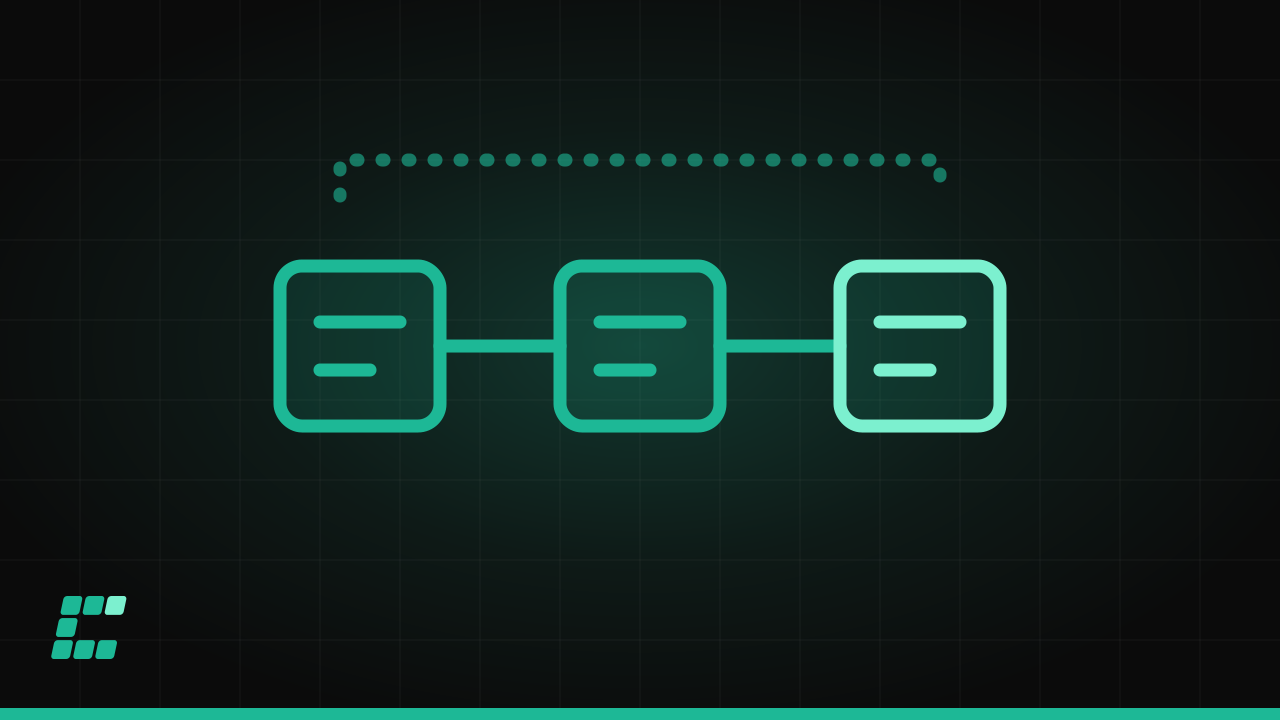
Proof of history (PoH) is a method Solana uses to prove that events happened in a specific order and that time passed between them. It works like a clock built into the blockchain. Instead of nodes constantly messaging each other to agree on timing, they can all read the same verifiable record.
How does Solana proof of history work?
A block producer runs SHA-256, a hash function, over and over, feeding each output into the next step. Because every hash depends on the one before it, the sequence cannot be computed in parallel or faked. Producing it takes real time.
When a transaction or message is mixed into this chain, its position proves it existed before the hashes that follow. Solana's documentation describes PoH as a set of proofs that data existed before a given point and that a set amount of time passed in between.
A key feature is that checking the chain is much faster than creating it. Different parts of the chain can be verified at the same time.
How does proof of history fit with leaders and slots?
Solana splits time into slots. In each slot, one validator acts as leader, processes transactions and produces a block. A leader schedule maps validators to upcoming slots. Because slots are measured in PoH hashes, they act as a shared logical clock that every node can count.
What is the difference between PoH and PoS?
They do different jobs. Proof of stake decides who gets a say and how much weight their vote carries. Proof of history is the clock those votes reference.
Solana's voting system, Tower BFT, has validators vote on specific PoH hashes. Each vote locks the validator into that fork for a timeout, and each new vote doubles the timeouts of earlier ones, so older votes quickly become practically irreversible. Once two thirds of stake has voted on a hash, it is final. So PoH is not a consensus mechanism on its own; it supports the stake-weighted one.
Is Solana replacing proof of history?
Yes, that is the plan. In September 2025, Solana validators voted with about 98% support for Alpenglow, a new consensus design that replaces proof of history and Tower BFT. It aims to cut finality from about 12.8 seconds to roughly 150 milliseconds.
As of October 2026, Solana's official upgrade page lists Alpenglow as active on testnet and devnet but not yet activated on mainnet. It is rolling out in phases, starting with the Votor voting component, with a later phase replacing how blocks are shared across the network. Until mainnet activation, proof of history remains part of how Solana runs.
This guide explains how things work. It is not financial, legal or tax advice. Last updated .